
Why Kitchen Clutter Comes Back (And How to Break the Cycle)
Quick answer: Kitchen clutter usually returns after a declutter not because of poor habits, but because there isn't enough usable, accessible storage for everything you actually need to keep. Fixing the storage — not just the sorting — is what makes a decluttered kitchen stay that way.
If this is the third spring in a row you've decluttered the same kitchen, you're not alone, and it's not a discipline problem. Most people who declutter a kitchen do a genuinely good job of it — bags to donate, bins full, cupboards wiped down. Then three, four, six months later, it looks exactly like it did before. That cycle is common enough that it's worth understanding why it happens, rather than just repeating the same clear-out every season.
The cycle, and why it keeps happening
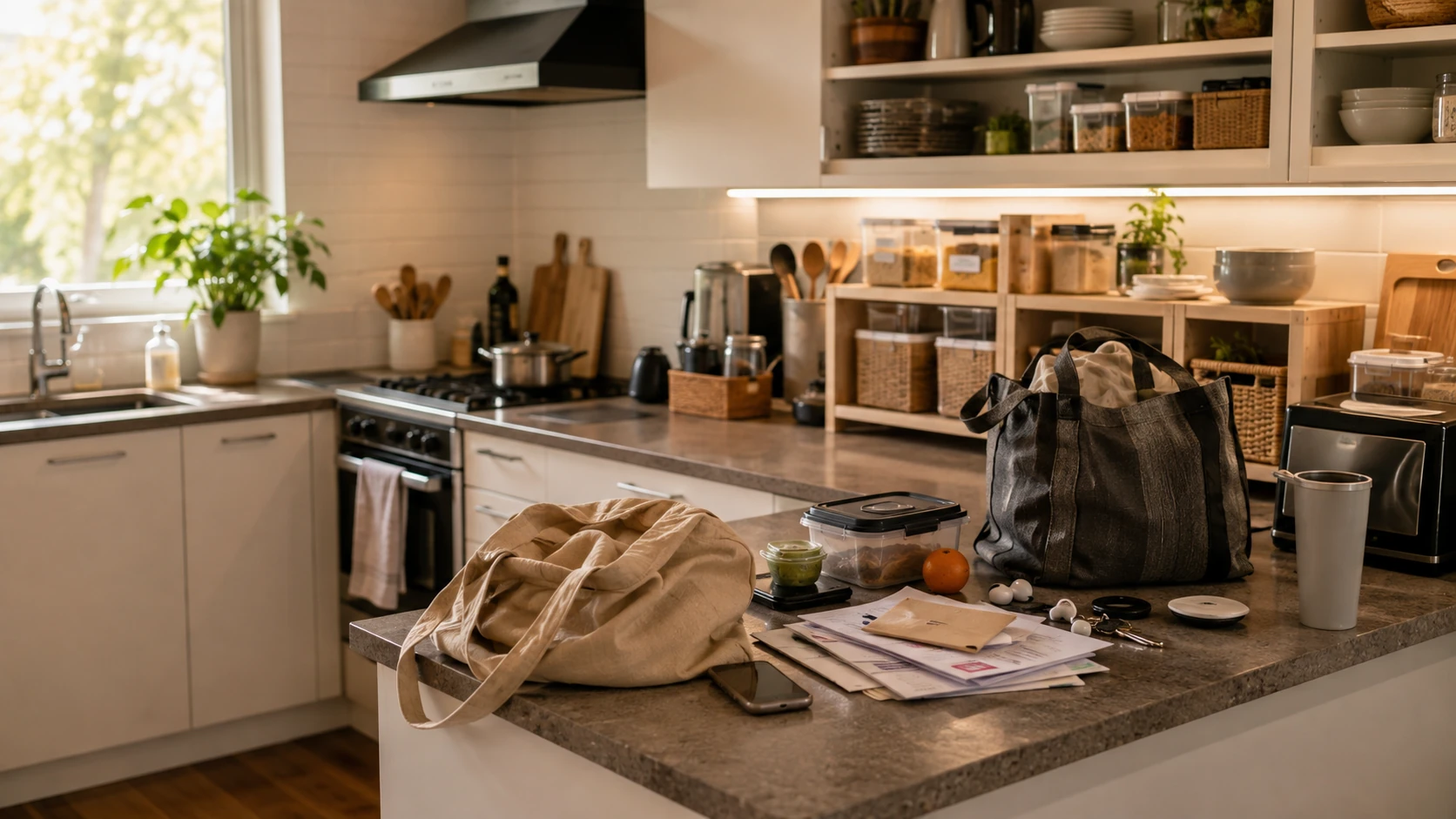
A typical kitchen declutter goes like this: sort everything, remove what's unused or unwanted, put the rest back "properly," feel great for a few weeks. Then real life resumes. Groceries come in faster than they're put away. Something doesn't have an obvious home, so it lands on the bench "for now." Within a couple of months, for now becomes forever, and the cycle starts again.
The pattern isn't really about how much stuff you own. It's about whether every single thing you keep has a specific, easy-to-reach place to live. When it doesn't, your brain (correctly) treats putting it away as a small daily decision rather than an automatic action — and small daily decisions are exactly the kind of thing that gets skipped when you're tired, in a hurry, or juggling everyone else's stuff in the same space.
It's rarely a "too much stuff" problem
Most kitchens aren't over-cluttered because people are hoarders. They're cluttered because standard kitchen storage — especially in homes built more than a decade or two ago — was never designed around how much people actually store today. Corner cabinets waste huge amounts of depth because nothing at the back is reachable without kneeling and reaching blind. Deep pantries hide their back third completely. Drawers get used for whatever fits rather than what makes sense.
None of that is solved by better sorting. It's solved by storage that's actually designed to be used — every part of it, not just the front third.
What actually breaks the cycle
Three things tend to make a decluttered kitchen stay decluttered:
Everything has one specific home. Not "somewhere in this cupboard" — a specific spot, ideally visible at a glance, so putting something away takes no thought at all.
Nothing requires excavation to reach. If getting to something means moving four other things first, it will stop happening within a few weeks, no matter how motivated you are.
The system matches how you actually live, not how a magazine kitchen is styled. A household of five needs different storage logic to a share house of two — and that's fine, as long as the storage flexes to match.
This is really the whole idea behind space liberation as a concept: it's less about owning less, and more about the kitchen finally working with you instead of against you every time you open a cupboard.
Where a renovation isn't actually the answer
It's a common assumption that fixing bad kitchen storage means a full renovation — new cabinetry, a different layout, a builder involved for weeks. For most kitchens, that's overkill for what's actually a storage design problem, not a structural one. Pull-out systems, corner solutions and drawer organisers retrofit into your existing cabinetry, which means the fix can be considerably smaller — and faster — than the renovation most people assume they need. It's less about spending less, and more about spending on the part of the kitchen that was actually broken.
FAQ
Why does my kitchen get messy again so quickly after I clean it?
Usually because items don't have a specific, easy-to-reach home. When "somewhere in that cupboard" is the plan, things end up on the bench instead — not from laziness, but because putting them away properly takes more effort than it should.
Is decluttering a personality thing, or a storage thing?
For most households, it's storage. People with genuinely well-designed, accessible storage tend to stay tidy without much conscious effort, because the easiest option is also the tidy option.
Do I need to renovate to fix bad kitchen storage?
Not usually. Pull-out pantry systems, corner solutions and drawer organisers work within your existing cabinetry, so most storage problems can be solved without a renovation at all.
How do I stop a corner cabinet from becoming a dumping ground?
Standard corner cabinets lose most of their usable space to areas you can't reach without kneeling. A corner pull-out system brings that entire space forward and into view, which is usually what actually fixes it — not better organising, better access.
If your kitchen has been through this cycle a few times, it's worth a proper look at what's driving it before you declutter again. A free phone consultation with our team can talk through what's actually going on in your space, and what would need to change to make it stick.
Features You'll Love!
- Durable stainless steel wire construction
- Lifetime warranty with full extension design
- Truly Unique Storage Options for almost any space
- We also have a measure and installation service, just give us a call.
- Accessible, No More Double Buying, And Great Solutions Put Into Place
September 11, 2026 - An Awkward Pantry, Sorted
September 10, 2026 - Efficient Kitchen Cupboard Arrangement: Practical Tips
September 8, 2026 - The Spring Decluttering Guide for Shared Kitchens
August 18, 2026 - Why Kitchen Clutter Comes Back (And How to Break the Cycle)
August 17, 2026 - 5 Things to Toss From Your Pantry This Spring
August 16, 2026 - Spring Cleaning in a Small Kitchen: Decluttering When Space (and Ownership) Is Limited
August 15, 2026 - The 15-Minute Kitchen Reset: A Spring Decluttering Checklist
August 14, 2026 - How to Get 140% More Storage Under Your Sink
June 26, 2026 - No Laundry Storage Space? Here's How We Fixed a Narrow Cabinet
June 26, 2026