
7 Signs Your Kitchen Is Working Against You
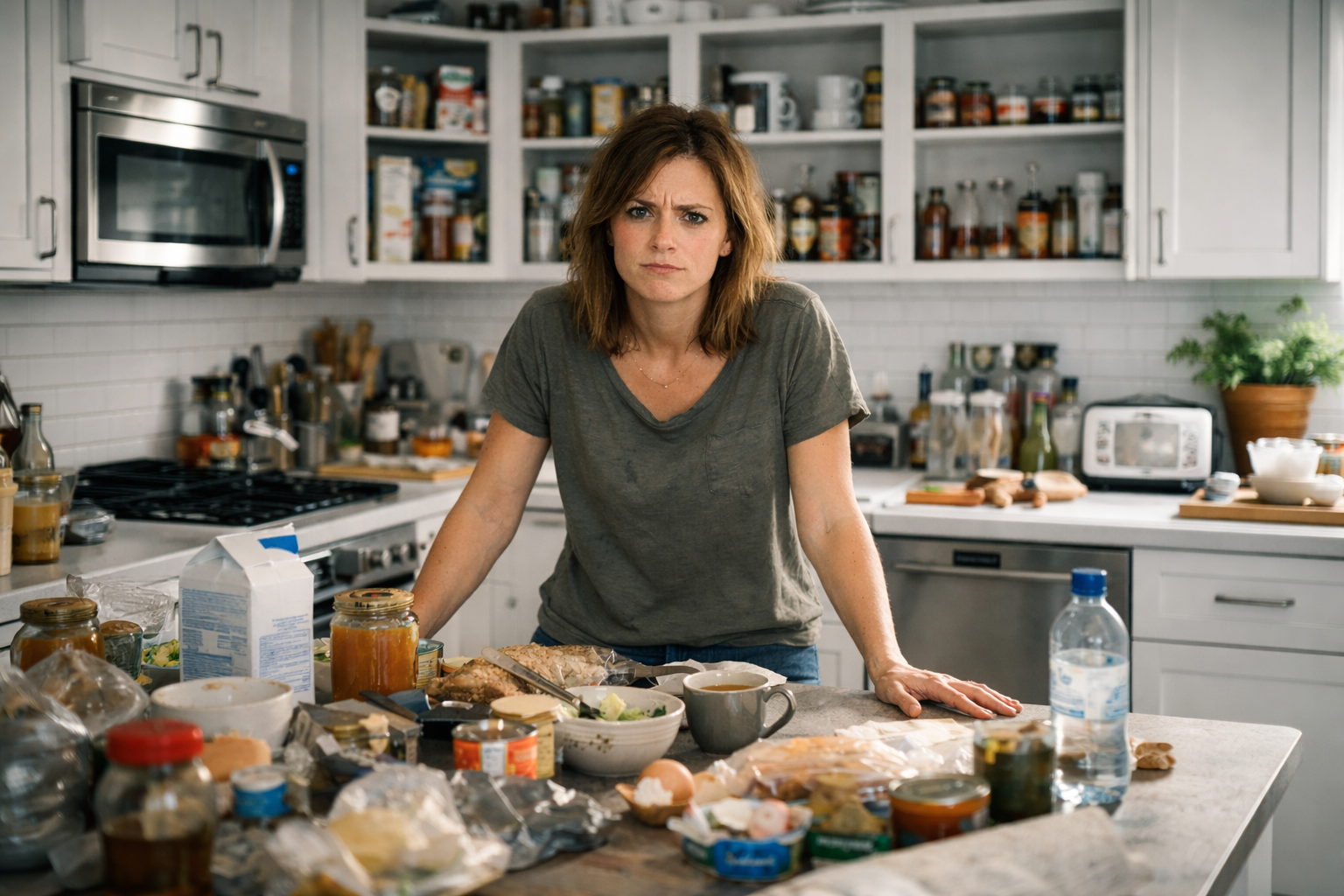
Most of us blame ourselves. We tell ourselves we're messy, disorganised, not the kind of person who has a tidy kitchen. But here's the thing: a well-designed kitchen almost organises itself. When storage works with the way you actually move and cook, you barely have to think about it.
When it doesn't? Every meal becomes a minor act of frustration. Cupboard doors flung open, things stacked in front of other things, a drawer that jams if you don't lift it just right. You're not the problem. Your kitchen is.
Here are seven signs that your kitchen is actively working against you — and what each one is really telling you.

You have to unpack the cupboard to find anything at the back
You know the routine. You need the roasting tray, which is absolutely behind the colander, which is wedged under a stack of baking tins. Three minutes later, the bench is covered in things you didn't want and you're already irritated before you've started cooking.
This is the classic symptom of fixed shelf storage with no depth management. Deep cupboards with static shelves turn into archaeological digs — the things you use most end up buried behind the things you use least, because that's just how stacking works.
What your kitchen is telling you: the problem isn't the clutter, it's that nothing pulls out. When storage comes to you instead of you going to it, the back of the cupboard becomes just as usable as the front.
You've given up on certain cupboards entirely
There's that one cupboard. You know the one. You open it occasionally, stare into the abyss, then quietly close it again and reach for something else. Maybe it's the corner cupboard, maybe it's the one that's too deep, maybe it's the one with the shelf at exactly the wrong height for everything you own.
Dead storage is surprisingly common — and surprisingly wasteful. A cupboard you don't use is paying rent in your kitchen and delivering nothing. In smaller homes and apartments, that's real estate you genuinely can't afford to lose.
What your kitchen is telling you: that space exists, it's just inaccessible. The right internal organisation can reclaim it entirely — turning a chaotic dead zone into some of the most useful storage in the kitchen.
Your bench is permanently covered in things that "live" there
The bench-top toaster that hasn't moved in two years. The fruit bowl. The coffee machine, the kettle, the random collection of things that have simply colonised the only flat surface you have. You tell yourself you'll clear it, but where would everything go?
When cupboard and pantry storage is inefficient, items migrate to the bench because it's the path of least resistance. The bench becomes storage by default rather than workspace by design. This makes small kitchens feel dramatically smaller than they are.
What your kitchen is telling you: your internal storage isn't working hard enough. When pull-out systems and drawer organisers do their job properly, the bench gets cleared — not because you tidied it, but because everything finally has a logical home.
Getting dinner ready feels like a physical workout
Bending down to reach the bottom shelf. Stretching up on your toes for the pasta you use every week. Twisting awkwardly into a corner to retrieve a pan. If cooking involves this much physical negotiation, you're not imagining it — the ergonomics of your kitchen storage are genuinely wrong.
Most kitchens are designed around a generic template that doesn't account for how people actually use their space. The things you reach for most often should require the least effort to access. That's not a luxury — it's basic usability.
What your kitchen is telling you: accessibility matters more than storage volume. A kitchen where everything is genuinely easy to reach — regardless of height, mobility, or how tired you are — is one you'll actually want to use.
You buy duplicates of things because you forget you have them
Four tins of chickpeas. Two identical spice jars, one at the front and one lost at the back. Cooking oil you bought because you couldn't see the other bottle. This isn't forgetfulness — it's a visibility problem masquerading as a memory problem.
When storage is deep and static, the back half of every shelf is effectively invisible. You operate on what you can see. So you buy what you can see you're out of, and the things at the back multiply into a stockpile nobody intended to build.
What your kitchen is telling you: when you can see everything at a glance — when pantry shelves pull out fully and nothing hides behind anything else — you stop buying duplicates. Most people are surprised by how much food they actually had all along.
More than two people in the kitchen at once causes chaos
One person opens a cupboard and the other has to flatten themselves against the bench. Someone pulls out a drawer and it blocks the walkway. Cooking together isn't relaxing — it's a negotiation of space, and someone usually retreats to the lounge room to avoid the friction.
As more Australians live in shared or multi-generational households — partners, adult children, parents, housemates — the kitchen needs to work for multiple people, not just one. A kitchen that can only accommodate one cook at a time isn't a kitchen, it's a corridor.
What your kitchen is telling you: internal organisation and flow are connected. When cupboards open smoothly, items are instantly reachable, and nothing blocks a pathway, the kitchen suddenly works for two — or three — people at once.
You simply don't enjoy cooking anymore — and you used to
This one runs deeper than the others. You used to cook more. Maybe you used to cook well, or with some enthusiasm. But these days you reach for the takeaway menu more often than not, and the kitchen feels like a chore before you've even started.
There's a reason for this. Friction accumulates. Each individual annoyance — the stuck drawer, the avalanche when you open the pots cupboard, the bench with no clear space — is small on its own. But kitchens are used multiple times a day, every day, and the cumulative weight of constant small frustrations does something to your enthusiasm.
What your kitchen is telling you: this is the most important sign of all. A kitchen that works — where opening a cupboard is satisfying, where everything is where you expect it, where the space feels calm — genuinely changes how you feel about being in it. People cook more. Enjoy it more. The kitchen becomes a room again, not just a room you endure.
If you recognised yourself in two or three of these signs, you're in the majority. Most Australian kitchens — particularly in apartments and smaller homes — weren't designed with real, daily use in mind. They were designed to photograph well and sell a property.
The good news is that none of this requires ripping out your entire kitchen. The right internal storage system can transform what you already have. Pull-out pantry shelves, drawer organisers, soft-close mechanisms, accessible lower storage — these aren't cosmetic upgrades. They change the entire experience of being in your kitchen.
Tansel was built around a simple belief: that you should actually want to use your kitchen. Not endure it. Not apologise for it. Use it, enjoy it, and feel good in it — regardless of how big or small it is.
Features You'll Love!
- Durable stainless steel wire construction
- Lifetime warranty with full extension design
- Truly Unique Storage Options for almost any space
- We also have a measure and installation service, just give us a call.
- Accessible, No More Double Buying, And Great Solutions Put Into Place
September 11, 2026 - An Awkward Pantry, Sorted
September 10, 2026 - Efficient Kitchen Cupboard Arrangement: Practical Tips
September 8, 2026 - The Spring Decluttering Guide for Shared Kitchens
August 18, 2026 - Why Kitchen Clutter Comes Back (And How to Break the Cycle)
August 17, 2026 - 5 Things to Toss From Your Pantry This Spring
August 16, 2026 - Spring Cleaning in a Small Kitchen: Decluttering When Space (and Ownership) Is Limited
August 15, 2026 - The 15-Minute Kitchen Reset: A Spring Decluttering Checklist
August 14, 2026 - How to Get 140% More Storage Under Your Sink
June 26, 2026 - No Laundry Storage Space? Here's How We Fixed a Narrow Cabinet
June 26, 2026